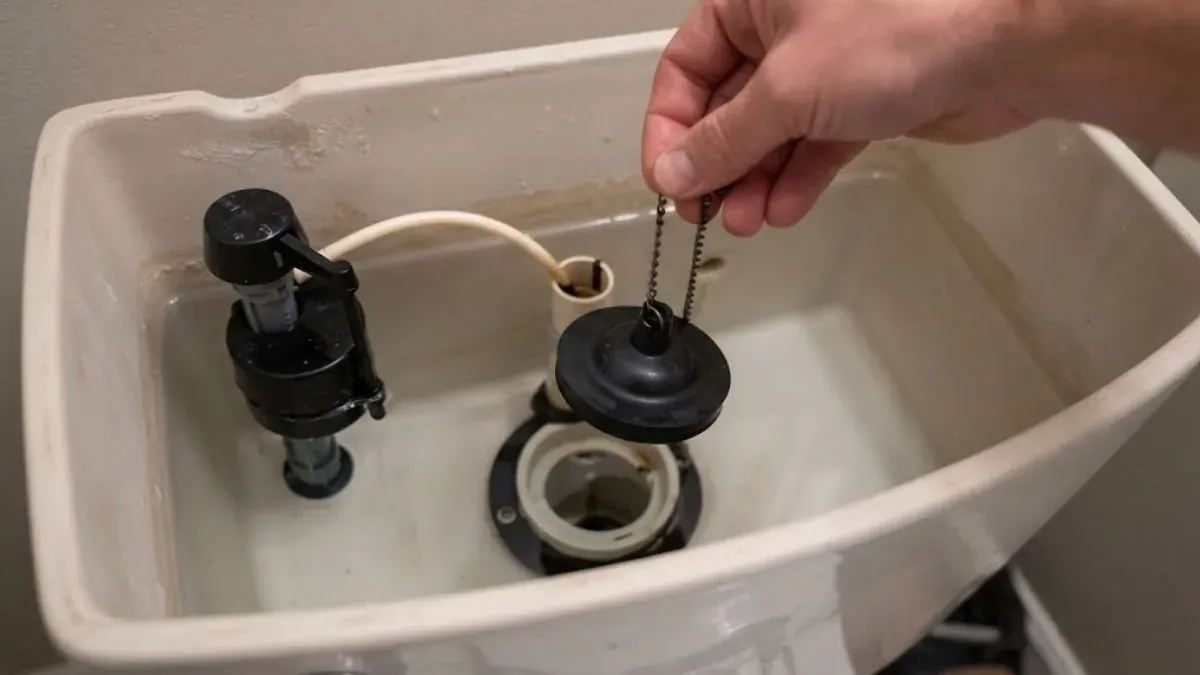
Why tanks crack and why it matters
A porcelain tank is brittle. Cracks appear from impact, from overtightened tank bolts, from freezing in a cold room or from age and stress at the bolt holes. A crack that seeps is already letting water out under constant pressure.
Even a small leak can run for weeks without notice and rot a subfloor or stain a ceiling below. A sudden full failure dumps the whole tank, usually about a few gallons, onto the floor.
The first question is not whether epoxy sticks. It is whether the crack is the kind a patch can hold.
When epoxy might be worth trying
These conditions make a patch more reasonable.
- A hairline crack above the waterlineIt is not under constant water pressure, so a patch has a better chance.
- A chip or surface flawCosmetic damage can be filled without any structural role.
- A temporary fix while you wait for a new toiletEpoxy can buy a few days.
- A rental or short-term situationYou need time, not a permanent repair.
- A crack you can fully dry and reachThe surface must be clean and dry for epoxy to bond.
Epoxy or replacement: a simple guide
Use this to decide.
| Crack type | Epoxy | Better choice |
|---|---|---|
| Hairline, above the waterline, dry | May hold briefly. | Plan to replace soon. |
| Below the waterline or actively leaking | Unlikely to hold. | Replace the tank. |
| At a bolt hole | Not reliable. | Replace the tank or toilet. |
| Crack in the bowl | Do not rely on epoxy. | Replace the toilet, see toilet repair. |
| Multiple cracks or old toilet | Not worth the effort. | Replace the toilet. |
If you try epoxy: how to apply it
Shut off and drain
Close the supply valve, flush and sponge out the tank until the crack is dry.
Clean and rough up
Clean the area with rubbing alcohol and lightly sand around the crack.
Mix and apply
Use a two-part epoxy rated for porcelain and wet use. Work it into the crack and spread it past the ends.
Cure fully
Follow the label for cure time before you refill the tank. Do not rush it.
What epoxy cannot fix
A tank that leaks from the bolts, a gasket between tank and bowl or a worn flush valve is not a cracked tank. Those are cheaper repairs, and epoxy is the wrong tool for them. Check the water path before you blame the porcelain.
Epoxy also does not restore strength. A porcelain tank holds several gallons, and the lid and bolts add stress. If a crack opens further, the tank can fail with little warning.
If you smell dampness near the base or find the floor soft, stop and call. A rotted subfloor is a bigger repair than a new toilet.
Checking the real source of the leak first
Before you buy epoxy, dry the outside of the tank with a towel and press a dry paper towel against each suspect spot. Add a few drops of food coloring to the tank water and wait twenty minutes. Color on the towel or the floor shows exactly where water is escaping.
Water that appears at the supply connection is a loose nut or a worn washer. Water at the two bolts at the bottom of the tank is a worn rubber washer. Water between the tank and the bowl is a failed gasket. All three are small repairs that need no epoxy.
Only a crack in the porcelain itself brings epoxy into the picture, and by then you can judge whether the crack is on the wet side and under pressure.
Lenexa notes: replacement, permits and water use
Lenexa has adopted the 2018 International Plumbing Code (IPC). A like-for-like toilet swap usually does not need a permit, but moving a toilet or adding a bathroom does, and Lenexa Community Development at 913-477-7725 can confirm what applies.
WaterOne supplies Lenexa and publishes an annual water quality report. A toilet that runs constantly after a repair wastes water you pay for, so check for a running flapper before you call it done.
We replace tanks and whole toilets here in Lenexa and in nearby Overland Park, and our line is open day and night for leaks.
Questions homeowners ask
For a dry hairline crack above the waterline, epoxy can hold for a while. For a leaking or structural crack, replace the tank.
It varies. Some patches hold for months, others fail quickly. We do not recommend relying on it for the long term.
A tank must match the bowl. If the toilet is old or parts are hard to find, replacing the whole toilet is often simpler.
It can be. A crack that leaks can flood a floor. Close the shutoff behind the toilet if you see water.
A sudden failure that floods a room may be covered. A slow seep over time may not. Ask your insurer.
Wondering whether yours is worth patching? Describe where the crack is and how old the toilet is. (855) 575-2890, any hour.