Start with the meter: the free test you can do now
Turn off every faucet, the ice maker and the washing machine. Look at the meter. If the low-flow dial is still turning, water is moving somewhere in the pipe between the meter and your fixtures.
Now shut the main valve inside the house. If the meter stops, the leak is inside your house. If it keeps turning, the leak is on the service line between the meter and the foundation.
WaterOne, the water utility for the Johnson County area, notes that it has no record of lead service lines in its distribution system and offers a Service Line Lookup Tool that shows your service line material. That tool helps us understand the pipe we are testing.
Symptoms that point to a hidden leak
Leaks announce themselves in odd ways. These are the signs that justify a detection visit.
- A water bill that jumped without explanationCompare three months. A steady climb with no change in habits suggests a slow leak.
- A meter that runs with fixtures offThis is the clearest sign of a leak somewhere downstream.
- Warm spots on a floorA hot water line leaking under slab or in a wall can warm the surface above it.
- Wall or ceiling stainsBrown rings on drywall, bubbling paint or a musty smell suggest moisture inside the cavity.
- Sound of running water at nightA hiss or trickle when everything is off often means a pressurized pipe is leaking.
How we find a leak without opening every wall
We layer methods because no single tool finds every leak.
| Method | What it detects | Best used for |
|---|---|---|
| Pressure test | Whether a supply line holds pressure. | Confirming a leak exists and isolating hot or cold side. |
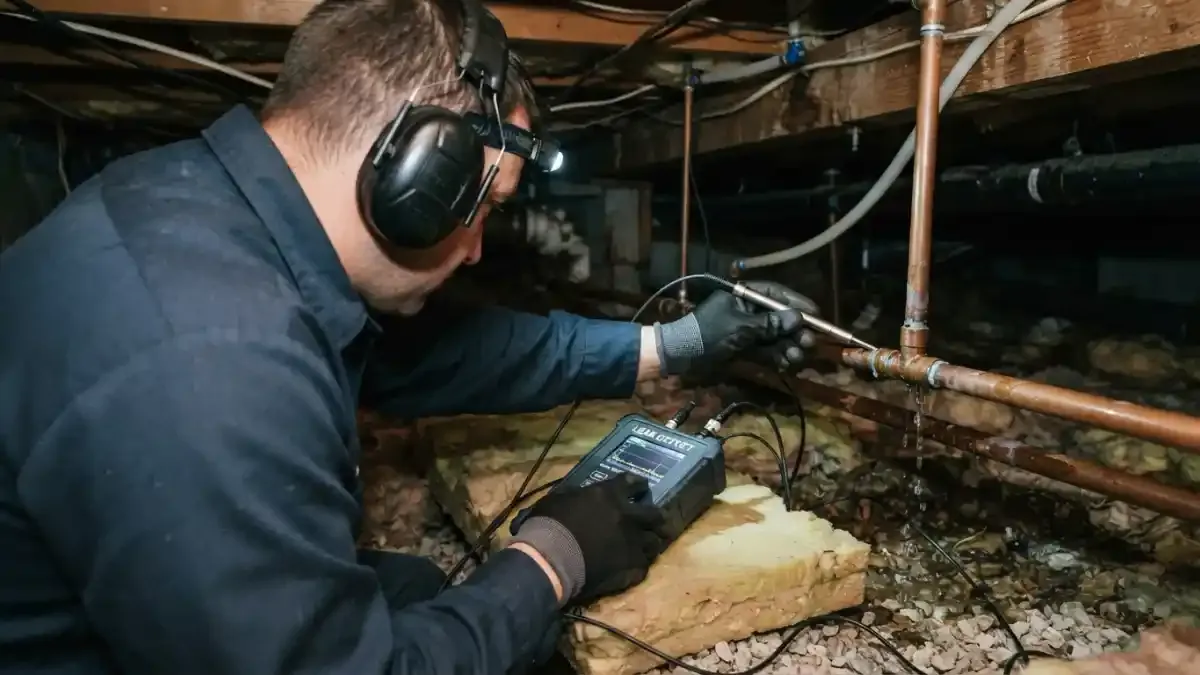
| Acoustic listening | The sound of water escaping a pressurized pipe. | Pinpointing under slab or behind a wall. |
| Thermal imaging | Temperature differences from wet or warm areas. | Hot water leaks, ceilings, radiant paths. |
| Moisture meter | Moisture in drywall, wood and subfloor. | Mapping the wet area after a leak starts. |
| Camera | Interior pipe condition. | Drain line leaks and cracked pipes. |
Where a leak sits near electrical or gas, we stop and plan access before cutting anything.
Ceiling, wall, crawlspace and under-house leaks
A ceiling stain is rarely right below the leak. Water travels along joists and drops where the surface first gives way. We trace it back with a moisture meter and thermal camera, check supply lines, drain lines and the roof above, and only then decide where to open.
Many Lenexa homes have basements, and the City of Lenexa requires egress in finished and unfinished basements and bedrooms. A leak in a finished basement ceiling can be a supply line, a drain, or the shower above it, and we test each separately.
Underground and buried-line leaks need a different approach, and our locate work for those is described in the water line paragraph below.
Yard, irrigation and water service line leaks
A leak between the meter and the house shows up as a soft spot in a lawn, a puddle in a dry stretch of yard, or a meter that runs when the house is off. Irrigation lines are a second source, especially after a hard freeze.
We shut the main inside the house to confirm the leak is on the buried line, then pinpoint it acoustically before digging. If the service line needs replacement, we explain the options and any permit steps under the 2018 International Plumbing Code (IPC) that Lenexa has adopted. Lenexa Community Development at 913-477-7725 can confirm what applies.
Pool and spa leaks are a different system, and we focus on household plumbing here.
Leak detection pricing factors
Detection is priced as a diagnosis, separate from repair.
Insurers often cover resulting water damage from a sudden leak but not the pipe itself or long-term seepage, so ask about your policy terms early.
Want your real number? Call (855) 575-2890.
Questions homeowners ask
Yes. We dispatch 24/7 for active leaks, ceiling stains and meters that will not stop, and we begin by stopping the water before pinpointing the source.
We pressure test the lines, listen along the wall with acoustic equipment, and scan with thermal imaging and a moisture meter before opening only the area that needs it.
Yes. Isolating the hot side from the cold side with the water heater valves and a pressure test usually answers it quickly.
It can be. Do the meter test with everything off. If the low-flow dial moves, there is a leak somewhere, and we can trace it.
Basements and crawl spaces are more common than slabs in many Lenexa homes, but slab leaks still occur. Warm floor spots and a running meter are the usual signs.
Yes. Detection and repair are separate steps with separate quotes, so you see the finding before you decide.
Not sure it is a leak at all? Describe the meter, the bill and any stains, and we will tell you what to check first. (855) 575-2890, any hour.