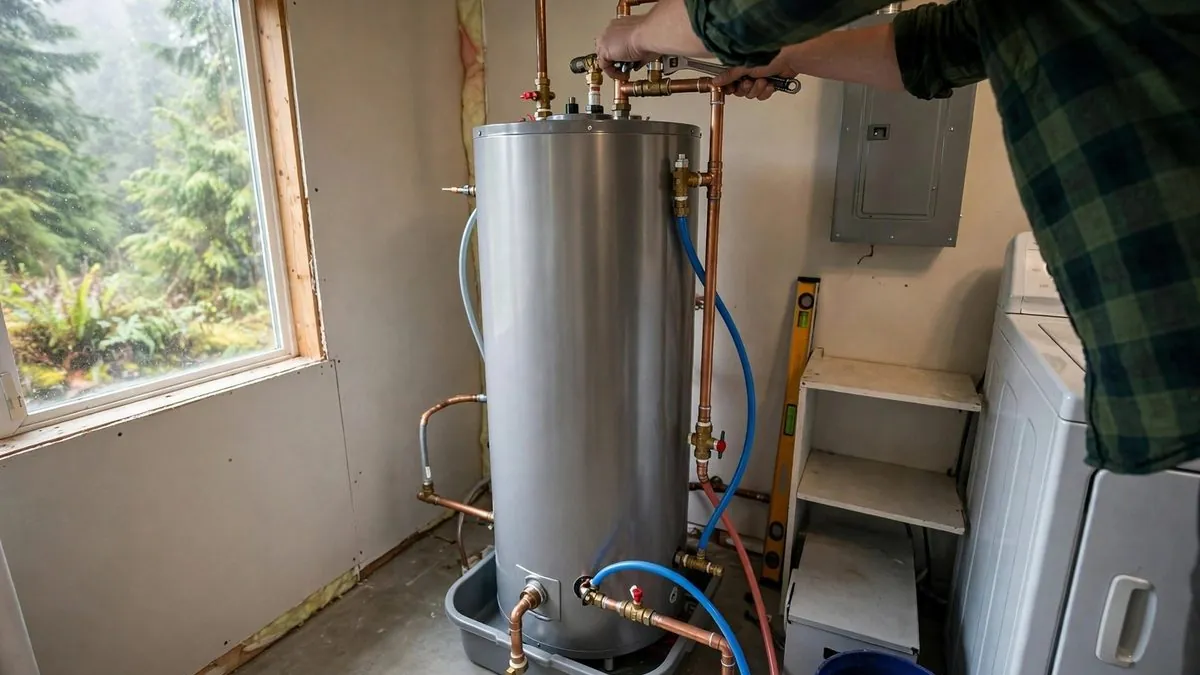
What replacing a water heater really involves
The job sounds simple: turn off water and power or gas, drain the old tank, disconnect it, set the new one and reconnect. In practice each of those steps has details that matter.
A tank full of water weighs several hundred pounds when filled, and an empty one is still heavy and awkward on stairs. The new unit needs the correct shutoff, a dielectric union or flex connectors, a temperature and pressure relief valve and a discharge pipe. Gas heaters add a gas connection, a sediment trap and a vent that must draw properly.
Each of these is a place where a shortcut becomes a problem later.
The real risks of getting it wrong
These are the failures plumbers are called to fix after a DIY job.
- Gas leaksA loose gas fitting can leak and cause fire or explosion.
- Carbon monoxideA poor vent connection can send exhaust into the home.
- Scalding or overpressureA missing or miswired relief valve is a serious safety failure.
- FloodingA weak supply connection or a skipped drain can flood a basement.
- Insurance and resaleAn unpermitted install can complicate a claim or a home sale.
Electric, gas and tankless: how hard each one is
The fuel changes the risk.
| Type | What the install involves | DIY difficulty |
|---|---|---|
| Electric tank | Water lines, a 240 volt circuit, relief valve and discharge pipe. | Moderate, but electrical work needs care. |
| Gas tank | Gas line, venting, draft check and combustion safety. | High, best left to a licensed plumber. |
| Gas tankless | Gas sizing, venting, condensate and water connections. | High. |
| Electric tankless | Large dedicated circuit and panel capacity. | High, often needs an electrician. |
| Heat pump or hybrid | Electrical, condensate drain and airflow space. | Moderate to high. |
We cover replacement and installation in full on our water heater replacement and water heater installation pages.
If you decide to do it: the safe order of work
Confirm the permit question
Call Community Development before you start.
Shut off fuel and water
Close the gas or cut the breaker, close the cold supply, open a hot tap and attach a hose to the drain valve.
Drain and disconnect
Disconnect water, gas or electric, the vent and the relief valve discharge.
Set and connect
Position the new unit, connect supply, vent and relief valve and check every joint.
Test and inspect
Fill the tank, bleed air, check for leaks and gas, then power up.
Lenexa notes: permits, code and licensed contractors
Lenexa has adopted the 2018 International Plumbing Code (IPC) and the 2017 National Electrical Code (NEC). Whether a given water heater swap needs a permit is a question for Lenexa Community Development at 913-477-7725, and permits@lenexa.com reaches the same office. Ask before you buy the heater.
The City says contractors who pull permits are expected to hold a Lenexa business license and a Johnson County Contractor's License. You can look up a contractor at cls.jocogov.org or call Johnson County Contractor Licensing at 913-715-2233.
If you live just east in Overland Park, that city handles its own permits, so call City Hall at 913-895-6000 and ask.
Choosing the right replacement before you buy
Size matters more than most people realize. A tank that is too small runs out of hot water in the middle of a shower, and one that is too large wastes energy keeping extra water hot. Check the capacity on your current unit and the number of people in the home before you buy.
Check the dimensions as well. Some new heaters are taller or wider than older ones and may not fit the closet, the vent path or the stairs. Measure the space, the doorway and the route from the truck to the utility room.
Look at the energy label and the warranty, and confirm the fuel type matches your home. Swapping gas for electric, or the reverse, turns a simple job into a bigger project.
Cost, time and what you actually save
The savings from DIY are the labor. Against that, you take on the risk, the haul-away of a heavy tank and the time of a project that rarely goes as fast as planned. A pro usually completes a like-for-like swap in a few hours with the right parts on the truck.
A new heater also comes with a warranty, and many warranties require proper installation. A poor install can void it, and you are left holding the repair bill.
If your heater is leaking, see our water heater repair page to compare repair and replacement.
Questions homeowners ask
That depends on permit and license rules. Ask Lenexa Community Development at 913-477-7725 before you start, and check what applies to homeowners.
Some homeowners do. Electrical safety and a correct relief valve and discharge pipe are critical, so be honest about your skills.
Gas lines can leak and vents can send exhaust into the home. Both are serious safety issues.
Many like-for-like swaps are completed in a few hours. Gas venting changes or a tankless conversion take longer.
It can. An unpermitted or faulty install may complicate a claim, so ask your insurer before you start.
Leaning toward a pro? Call and describe the heater. We will say what the job involves. (855) 575-2890, any hour.