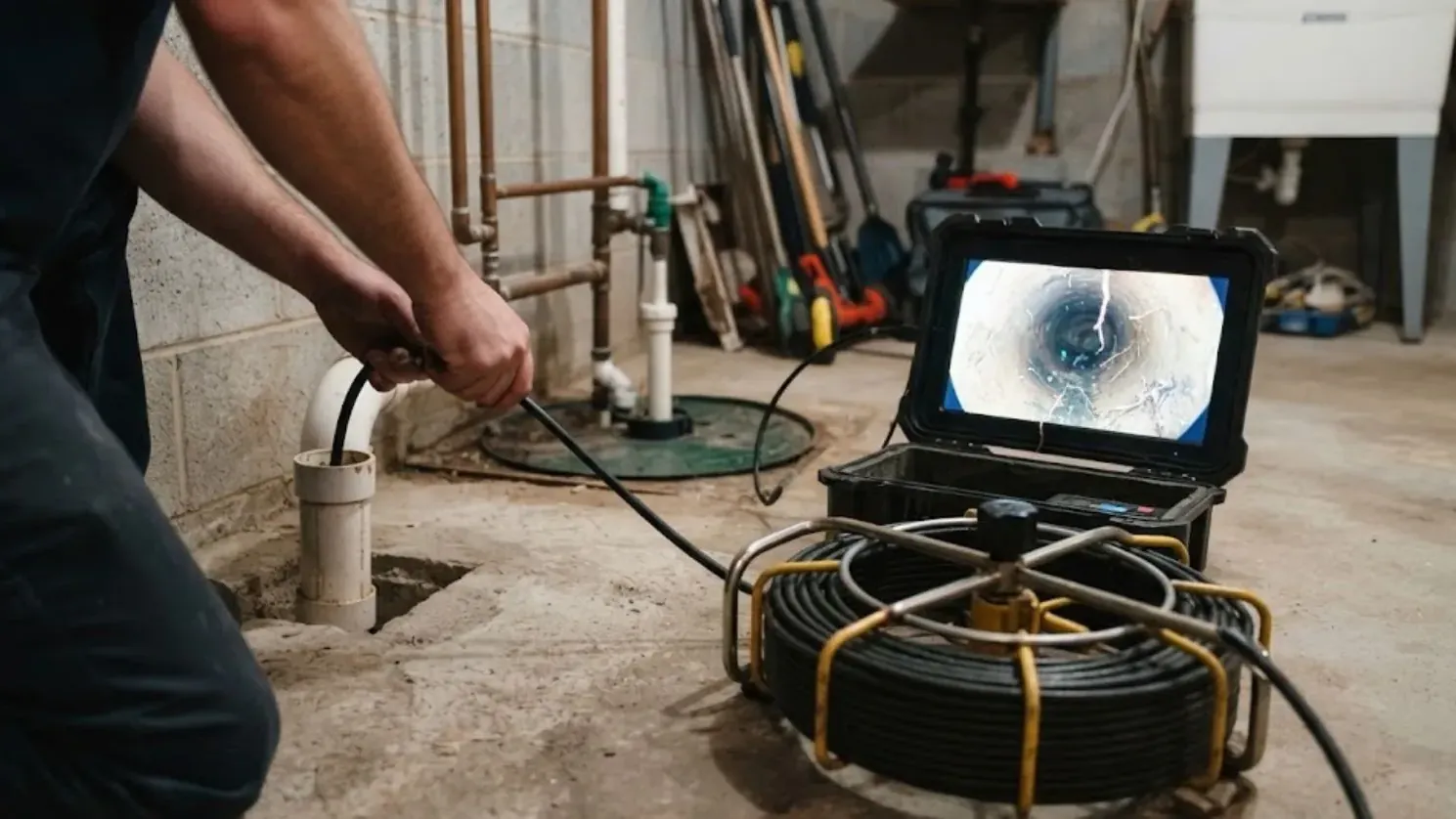
What a sewer camera inspection actually shows
A waterproof camera on a flexible rod travels through the cleanout or a pulled toilet, sending live video to a screen. We see the pipe wall, the joints, any standing water, roots and the point where your line meets the public main.
The camera head also carries a transmitter, so we can trace the line from above ground and mark its depth. That avoids guesswork before any dig.
You watch the footage with us, and we explain every finding. If something looks wrong, we show you the frame instead of describing it.
How an inspection visit runs
Find the access
We locate the cleanout, or pull a toilet if there is none.
Clean if needed
A heavily blocked line is cleared first so the camera can pass.
Run the camera
We record the full run to the main and note distances to each defect.
Review together
We explain what we saw and what, if anything, to do next.
When a camera inspection is worth the visit
An inspection is not for every home. It pays for itself in these situations.
- Repeat clogsIf cleaning does not hold, the camera shows why.
- Buying an older homeA pre-purchase scan reveals a problem before closing and gives you negotiating information.
- Slow drains throughout the houseThe main line may be narrowing, and the camera shows by how much.
- Before a remodel or landscape projectKnowing where the line runs avoids a cut pipe.
- After a repair or cleaningA post-work pass confirms the line is clear and sound.
Typical findings and what follows
This table links common camera findings to next steps.
| Finding | What it means | Usual next step |
|---|---|---|
| Roots at a joint | Roots enter through a small gap. | Cut roots now, plan a spot repair. |
| A belly | A sag holds water and solids. | Monitor or replace depending on depth. |
| Offset or separated joint | Pipe sections have moved apart. | Spot repair at the joint. |
| Heavy scale in cast iron | Interior roughness narrows the pipe. | Jet clean, then monitor. |
| Crushed or collapsed pipe | The pipe has failed structurally. | Replacement. |
Johnson County context for older and newer homes
Lenexa was incorporated in 1907, and its housing spans from older central subdivisions to new construction on the west side. Johnson County Wastewater serves the public sewer, and homeowners are generally responsible for the line from the house to the public main.
The county also runs the voluntary JoCo Inflow program, which has inspected more than 55,000 properties since 1983. If your camera shows a floor drain or sump pump tied to the sewer, that is a connection the program is meant to find, and it can be reached at 913-715-8550.
A camera finding that points to a hydro clean is a good time to read about hydro jetting, which clears scale and grease. Any repair that follows is done to the 2018 International Plumbing Code (IPC) that Lenexa has adopted.
What affects inspection cost
The visit is priced for the scope.
Pre-purchase inspections can be done on a schedule that fits your closing period.
Want your real number? Call (855) 575-2890.
Questions homeowners ask
Yes. We dispatch 24/7, and during a sewer backup we clear the line first and camera it to find the cause.
Most residential lines take about an hour, including setup and review. Longer runs or cleaning first take longer.
Yes. We can provide the recording so you can share it with a buyer, seller or insurer.
Yes. The camera transmitter lets us trace and mark the line and its depth before any dig.
We document it and you can report it to Johnson County Wastewater at 913-715-8600.
A cleanout makes access easiest. If there is none, we can usually enter through a pulled toilet.
Planning an inspection for a purchase or a repeat clog? Call to describe the situation and book a time. (855) 575-2890, any hour.