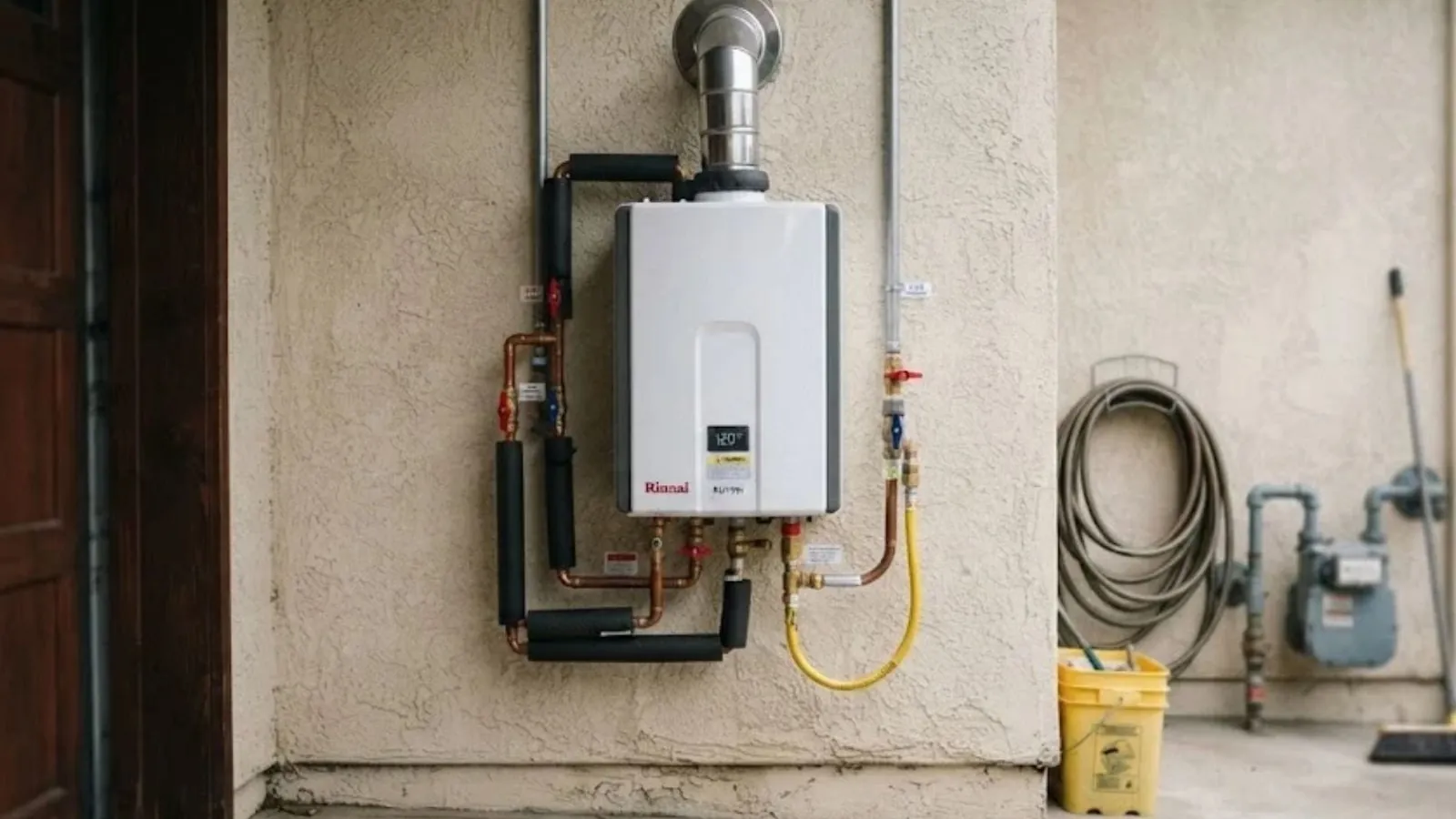
How a tankless water heater actually works in your house
A tankless heater fires a burner or electric element the moment water flows, then shuts off when the flow stops. There is no stored hot water, so output is limited by flow rate and temperature rise, not tank volume.
That is why a unit that works well for two showers can struggle when a third fixture opens in winter, when incoming water is colder. Sizing matters more than with a tank.
Gas models need correct line size, a proper vent and a condensate drain on high-efficiency units. Electric models need a lot of amperage, often more than an older panel offers.
Flush and descale: the maintenance most owners miss
Heat drives minerals out of water, and they coat the heat exchanger as scale. Scale reduces flow, raises error codes and shortens the life of the unit. A flush runs a descaling solution through the exchanger and rinses it clean.
WaterOne, which supplies treated water in the Johnson County area, publishes an annual water quality report with hardness values and explains that you divide total hardness in ppm by 17.1 to get grains per gallon. Pull the latest report, or test your tap, to see how aggressive scaling is likely to be at your address.
Flush frequency depends on water hardness and use. Many manufacturers call for an annual flush, and we follow the manual for your model.
Signs a tankless unit needs service
These symptoms usually show up before the unit stops.
- Error codes that returnMany codes relate to flow, ignition, venting or scale. Writing down the code speeds diagnosis.
- Cold water sandwichHot, then cold, then hot again can mean a flow sensor, a scaled exchanger or a mismatched recirculation setup.
- Lower hot water flowScale or a clogged inlet filter reduces the flow the unit sees.
- Noise during firingRumbling or popping can come from scale in the exchanger.
- Exhaust or condensate problemsA plugged vent or a clogged condensate line can shut the unit down.
Is tankless right for your Lenexa home
Use this comparison before you commit.
| Factor | Tankless | Tank |
|---|---|---|
| Space | Wall-mounted, saves floor area. | Needs floor space and a pan. |
| Gas supply | Often needs a larger gas line. | Standard gas line usually works. |
| Maintenance | Annual flush recommended. | Occasional flush and anode check. |
| Water quality | Hard water scales the exchanger. | Hard water builds sediment in the tank. |
| Upfront cost | Higher, with possible venting and gas work. | Lower for a simple swap. |
Gas line, venting and code for tankless installs
Lenexa has adopted the 2018 International Fuel Gas Code and the 2018 International Mechanical Code, which cover gas piping and venting for appliances like these. Tankless units draw a high burst of gas, so a line sized for a tank heater is often too small.
We calculate the total connected load, check the vent run and clearances, and confirm the condensate route before quoting. For permit questions, call Lenexa Community Development at 913-477-7725.
If a tankless unit is fighting you and you would rather go back to a tank, our water heater installation service covers that conversion.
What affects tankless pricing
Installed cost varies more than with a tank.
Warranty terms often depend on proof of regular flushing, so keep your service records.
Want your real number? Call (855) 575-2890.
Questions homeowners ask
Many makers recommend once a year. Harder water or heavy use can justify more often. We follow the schedule in your manual.
Often yes, but gas line size, venting path and condensate drainage need to be checked first. We confirm all three before quoting.
Codes usually point to flow, ignition, venting or scale. We read the code, inspect the vent and filter, and flush if scale is likely.
Yes. If you lose hot water or smell gas at night, call. For gas odor, leave the home and call 911 first.
It gives continuous hot water within its flow limit. Open too many fixtures at once and the unit cannot keep the temperature up.
WaterOne publishes hardness in its annual report. Check that report or test your tap, then flush on a schedule that matches the result.
Not sure your gas line can feed a tankless unit? Call and we will explain what we check first. (855) 575-2890, any hour.