Start with the number: test your tap water
Water treatment should follow a test, not a sales pitch. Hardness, iron, chlorine taste and other issues each need a different tool, and one system rarely fixes all of them.
WaterOne, which supplies Lenexa, publishes an annual water quality report with hardness listed in the data. Hardness appears in parts per million or grains per gallon, and you convert ppm to grains by dividing by 17.1. Look up the current report before you decide on a softener size.
You can also test your own tap with a test strip or a lab kit. If you have a private well or a different source, test that water directly.
Signs of hard water or other water quality issues
Minerals leave visible clues.
- White scale on faucets and shower headsCalcium and magnesium deposits build up as water dries.
- Spots on glasses and dishesDissolved minerals leave residue after the water evaporates.
- Dry skin or stiff laundryMineral-heavy water can leave soap residue.
- A water heater that rumblesScale at the bottom of the tank can cause popping noises and reduce efficiency. See water heater repair.
- Chlorine taste or smellA carbon filter can improve taste and odor.
Softener or filter: which one solves which problem
These are different tools for different problems.
| Problem | System | What it does |
|---|---|---|
| Scale and hardness | Water softener. | Swaps calcium and magnesium for sodium or potassium. |
| Chlorine taste and odor | Carbon filter. | Adsorbs chlorine and some organic compounds. |
| Sediment | Sediment filter. | Traps particles before they reach fixtures. |
| Drinking water improvement | Reverse osmosis at one tap. | Filters drinking water at a single faucet. |
| Iron and certain stains | Specialty filter. | Needs a lab test to pick the right one. |
A softener does not filter drinking water on its own.
What a softener does to your plumbing and appliances
Hard water leaves scale inside water heaters, on heating elements and in pipes. Over time it reduces efficiency and shortens appliance life. A softener reduces scale buildup and helps appliances work as designed.
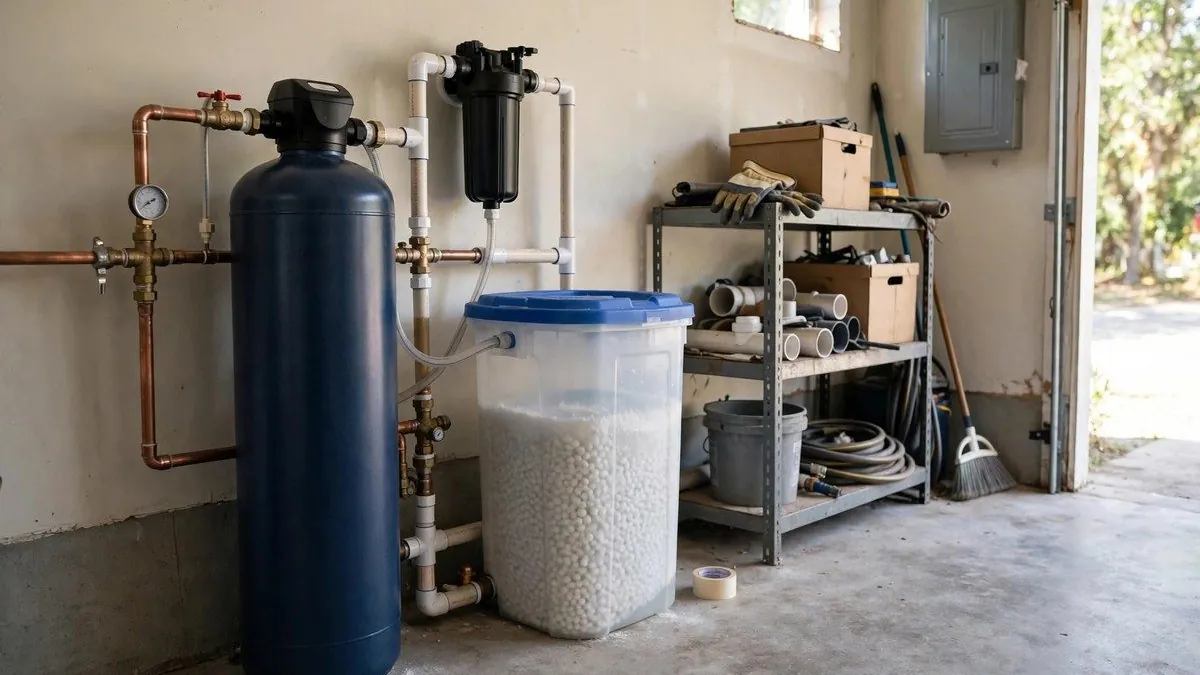
A softener needs a drain for its regeneration cycle, a power outlet nearby and salt or potassium to keep it working. It should be placed where the main line enters the house and before the water heater.
If you have a tankless unit, scale is a real concern, because small passages clog easily. Our tankless water heater page explains maintenance.
How we install a water treatment system
Review the test
We look at your water results and pick the right equipment.
Plan the location
We find a spot with a drain, power and room for service.
Install with bypass
We set the unit with a bypass valve so you can isolate it.
Set and show you
We program the unit and show you how to maintain it.
Permits, drains and salt discharge
A softener connects to the water main and needs a drain, and Lenexa has adopted the 2018 International Plumbing Code (IPC). Lenexa Community Development at 913-477-7725 can confirm whether your installation needs a permit.
Regeneration brine goes down the drain. Some communities limit salt discharge, so ask before you choose a model. We set the unit to regenerate only when needed, which saves salt and water.
For a home on a septic system, check with your septic professional first, since a softener adds water volume to the tank.
What affects water treatment cost
We quote after reviewing your water.
Treatment equipment is a home improvement, and it usually is not an insurance item, so budget for it as one.
Want your real number? Call (855) 575-2890.
Questions homeowners ask
Both. Water treatment is scheduled work. Our emergency line is open 24/7 for leaks, backups and burst pipes.
Check the WaterOne annual water quality report or test your tap with a strip or lab kit. Divide ppm by 17.1 to get grains per gallon.
It adds a small amount of sodium or potassium, usually not noticeable. Many people keep a separate drinking water filter.
Not always. A softener handles scale. A filter handles taste and odor. Test results tell us which you need.
Check the salt level regularly and have it inspected periodically. We can set up a schedule.
It can reduce scale buildup that makes heaters less efficient, though a heater should still be flushed on a schedule.
Curious whether your water needs treatment? Share what you see and we will point you to the right test. (855) 575-2890, any hour.