Start by finding where the water actually comes from
Water reaches a basement in a handful of ways. It seeps through the floor-wall joint when groundwater pushes up, it enters through cracks in the wall, it comes down from gutters and grade, or it comes from a plumbing leak that has nothing to do with the soil.
Treating the wrong source wastes money. A plumbing leak under the slab will not stop with an interior drain, and a grading problem will not stop with a sump pump. We start with a look at the walls, the grade outside and your plumbing before we propose anything.
If we suspect a pipe, leak detection can find it without tearing out the floor.
Signs your basement has a water problem
Moisture leaves a trail long before it floods.
- White, chalky deposits on wallsEfflorescence is mineral salt left behind when water moves through masonry.
- Musty smellPersistent odor often means damp materials and mold risk behind finishes.
- Damp spots at the floor-wall jointWater pushed up from below often shows here first.
- Peeling paint or bubbling drywallMoisture behind a finish lifts it from the surface.
- Stains on the bottom of stored boxesRepeated dampness leaves tide lines on whatever sits on the floor.
Basement water sources and the fix for each
Match the fix to the source.
| Source | Clue | Usual fix |
|---|---|---|
| Rising groundwater | Water at the floor-wall joint after heavy rain. | Interior drain tile and sump pump. |
| Wall cracks | Water streaks from a crack in the wall. | Crack repair and exterior drainage review. |
| Poor grade or gutters | Water enters after rain and the ground slopes toward the house. | Regrade, extend downspouts, clean gutters. |
| Plumbing leak | Water appears in dry weather too. | Leak detection and pipe repair. |
| Sewer backup | Water from floor drains, often during heavy rain. | Sewer line cleaning and a camera check. |
A basement can have more than one source at the same time.
Interior drainage systems explained
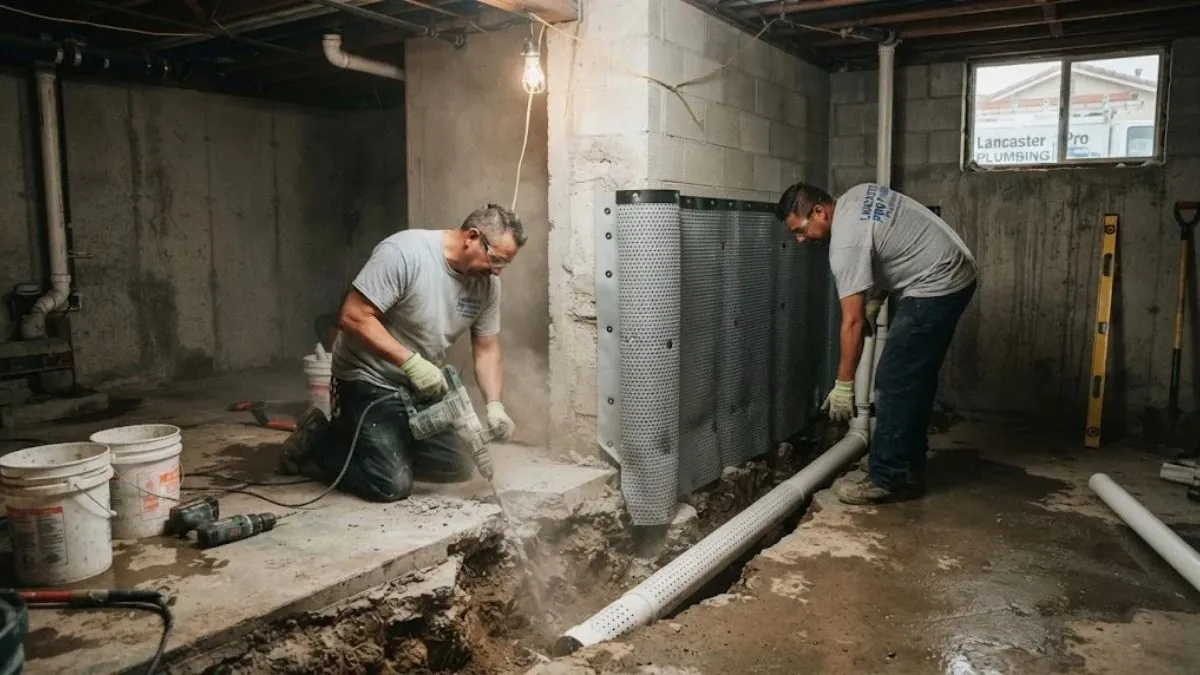
An interior drain system collects water at the footing, before it reaches the floor, and sends it to a sump pit. We cut a channel along the wall, lay perforated pipe in washed stone and restore the concrete. The water is then pumped outside.
This approach is practical on finished or partly finished basements because it needs no digging around the house. It does not stop water from reaching the wall. It gives the water a controlled path out.
Pairing a drain system with a battery backup pump keeps the system working through a storm outage. We also check that the discharge goes outside and not into the sewer.
Sump discharge, downspouts and the Johnson County sewer
Johnson County Wastewater says stormwater entering the sanitary sewer from sump pumps, downspouts and area drains can overload it. Its voluntary JoCo Inflow program has inspected more than 55,000 properties since 1983 and removed about 17,000 stormwater sources.
This matters for waterproofing. A system that sends groundwater into the sewer solves your basement and may contribute to someone else's. We discharge outside and away from the foundation.
If you want a free evaluation of whether your property is tied to the sewer, JoCo Inflow can be reached at 913-715-8550.
Lenexa homes and how basement water shows up
Lenexa was incorporated in 1907 and has grown steadily. Listing records place areas such as Whispering Hills in the 1970s and 1980s and Bristol Ridge in the 2010s, so foundation age and drainage details vary a lot from one street to the next.
Older foundations may have settled or have cracks. Newer ones often have drain tile that has clogged or a pump that was never sized for the lot. We look at what your foundation actually has before recommending anything.
Mold can follow persistent moisture, but we do not make health claims about it. For concerns about exposure, talk to your physician.
What affects waterproofing cost
We quote after we see the basement.
Seepage and groundwater are often excluded from homeowners policies, so check your coverage before you file.
Want your real number? Call (855) 575-2890.
Questions homeowners ask
Yes, for active water from a failed pump or a pipe. Our line is open 24/7. Waterproofing itself is planned work, scheduled after the emergency is controlled.
Each has a place. Interior drainage avoids digging around the house, and exterior work addresses the wall directly. We recommend based on what we find.
Tape a square of foil to the wall for a day. Moisture on the outside of the foil is condensation. Moisture behind it means water is coming through the wall.
Only if the water arrives through a pit or drain. Wall seepage and surface grading problems need other fixes.
Yes. A leaking supply or drain pipe can mimic groundwater. Water in dry weather is a strong clue.
Interior drainage and sump work may. Lenexa has adopted the 2018 International Plumbing Code (IPC), so ask Lenexa Community Development at 913-477-7725.
Planning a basement project and want to be sure the water is handled first? Call and describe what you have seen. (855) 575-2890, any hour.