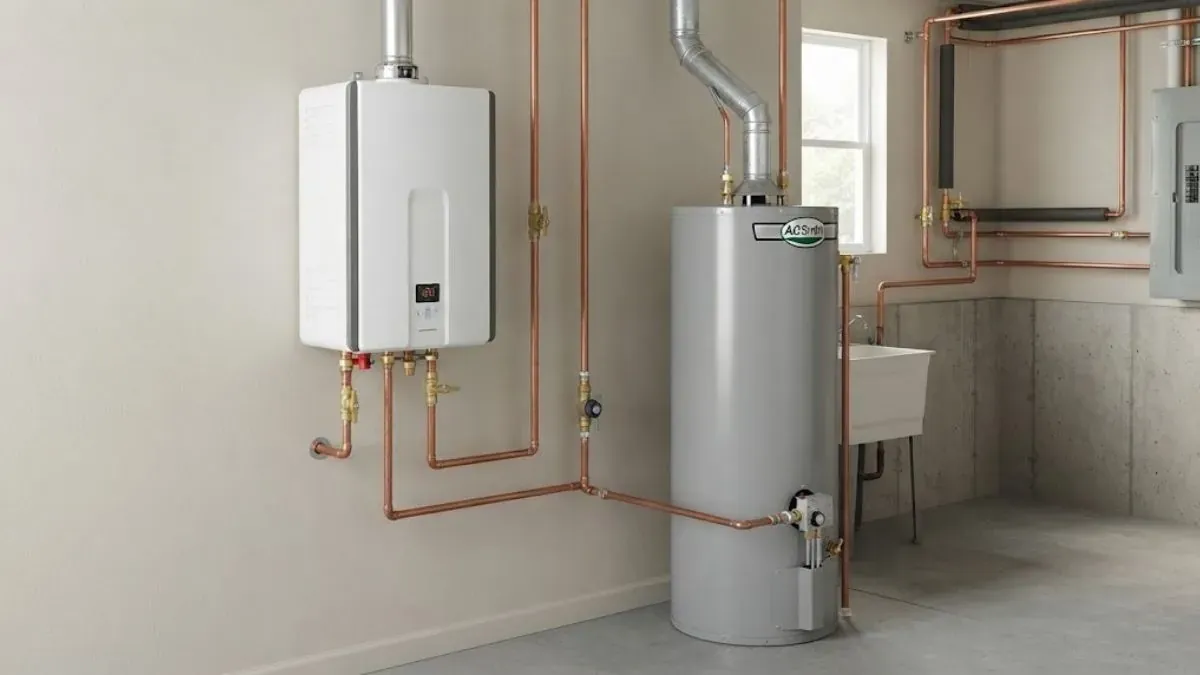
Start with who owns the water heater
If you rent an apartment, the landlord owns and chooses the water heater, and a tenant should not install one. Report a problem to the landlord or management in writing and keep a copy.
If you own a condo or townhome, check your association rules. Water heaters often sit in shared closets, and vents, gas lines or electrical panels may fall under association or building rules. Ask for written approval before buying anything.
If you own a small single-family home, the choice is yours, and the rest of this guide applies directly.
Electric or gas tankless in a small space
The fuel decides what the home needs.
| Type | What it needs | Watch for |
|---|---|---|
| Electric tankless | A large dedicated circuit and adequate panel capacity. | Panel upgrades can add cost, and a very large draw may exceed small-home service. |
| Gas tankless | A gas line of adequate size, proper venting and a condensate drain on some models. | Venting through a wall or roof, and a gas line that may need upsizing. |
| Point-of-use electric | A smaller circuit near a single sink. | Serves one fixture, not a whole home. |
Ask for the load calculation before you buy. It shows whether your gas line or electrical panel can support the unit.
Signs a tankless unit may suit a small home
It is not for everyone.
- Limited spaceA wall-mounted unit frees up floor space where a tank would sit.
- Older tank near the end of its lifeA planned replacement lets you compare options without the pressure of a failure.
- Hot water used in short burstsA single person or couple often does well with a correctly sized unit.
- Gas service already in the homeA gas model may be easier than an electric one with a limited panel.
- Willingness to maintain itUnits need periodic flushing, especially in homes with mineral-heavy water.
Sizing it right: flow rate and temperature rise
A tankless unit is rated by flow in gallons per minute at a given temperature rise. The rise is the difference between the incoming cold water and the hot water you want. Cold incoming water in winter lowers the flow a unit can deliver, so size for the coldest months.
Add the flow of fixtures you might run at once, such as a shower and a dishwasher. A small home with one bath and a low-flow showerhead needs less than a larger home with two showers.
If you undersize the unit, the water turns lukewarm when a second fixture opens. If you oversize it, you pay more than you need to.
Scale, flushing and what it means for maintenance
Tankless units have narrow passages that scale can clog. WaterOne publishes an annual water quality report that includes hardness data, and you can also test your own tap. Use the result to decide how often to flush and whether a softener makes sense.
Maintenance is simple but not optional. A flush with a descaling solution on a schedule keeps flow and efficiency up. Our tankless water heater page explains the service in detail.
If your home has hard water and you want to protect any water heater, read about water softener and filtration options.
What to check in Lenexa before you buy
Lenexa has adopted the 2018 International Plumbing Code (IPC) and the 2017 National Electrical Code (NEC). A tankless installation touches both, since it needs venting or a circuit and a connection to the water lines. The Community Development office at 913-477-7725 can tell you which permits apply.
Johnson County licenses contractors, and you can check a contractor at cls.jocogov.org or by calling 913-715-2233. Use a licensed contractor for gas and electrical work, and ask for the permit to be pulled.
Older homes in areas such as Whispering Hills may have a gas line sized for a tank heater, while newer ones such as Bristol Ridge may already have room for a larger unit. The same questions come up for owners in Overland Park, which we also serve.
What drives the cost of a tankless install
Costs vary by home, so we price after a look.
A tankless heater often costs more up front than a tank. Weigh that against space, efficiency and expected life.
Want your real number? Call (855) 575-2890.
Questions homeowners ask
Normally no. The landlord owns the water heater and any change needs their written approval. Report problems to the landlord and keep a copy.
Often yes, but check association rules first. Venting, gas lines and electrical panels may be shared or regulated.
It depends on what the home already has. If you have gas and room for venting, gas is often simpler. If the panel is small, electric may need an upgrade.
Often yes, because it involves gas, electrical or venting work. Ask Lenexa Community Development at 913-477-7725.
Not in the same way a tank does, but it can run short if you run too many fixtures at once for its flow rating.
Want to know whether a tankless unit makes sense for your home? Call and describe the space and the fuel. (855) 575-2890, any hour.